

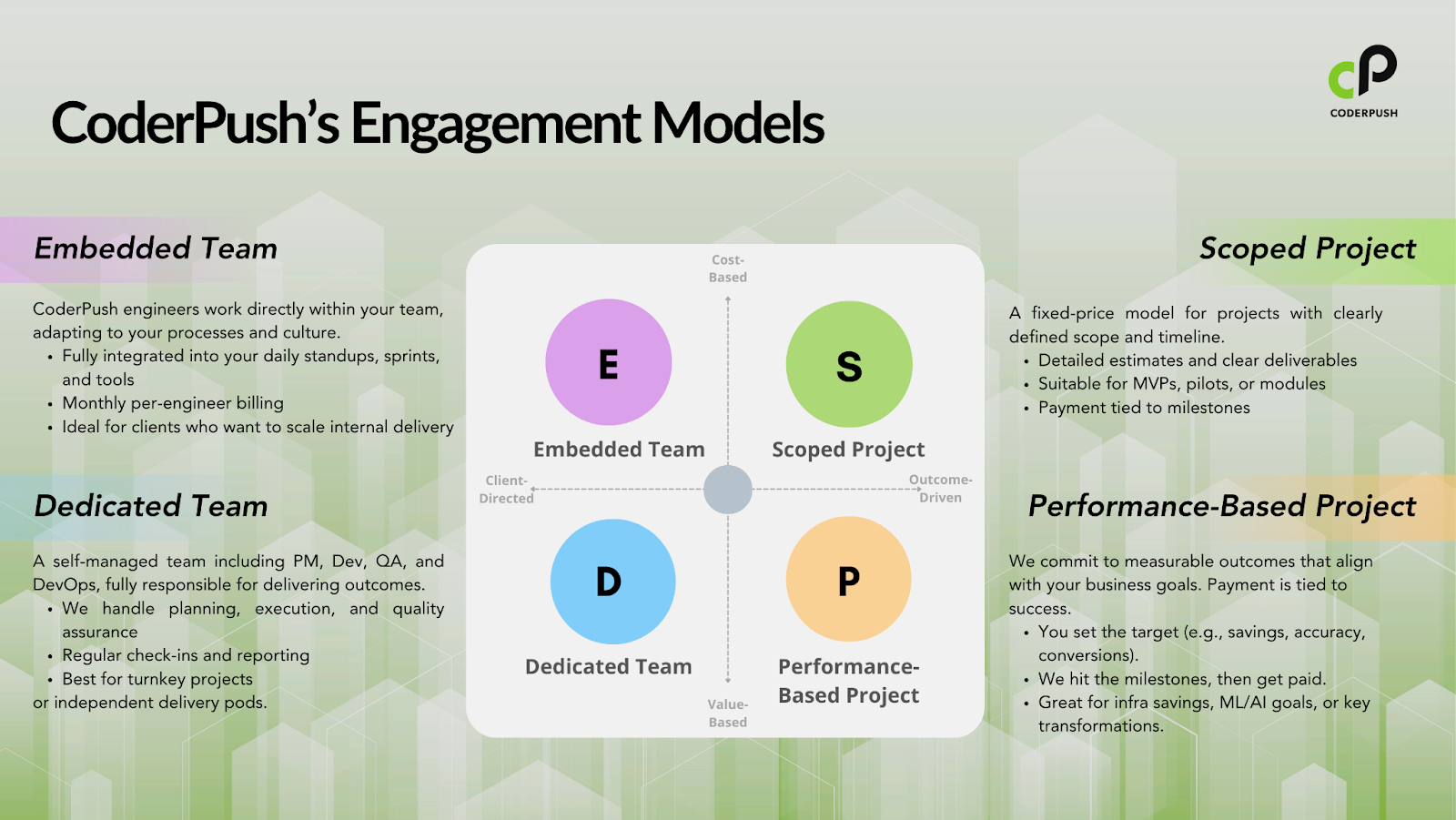
As part of the CoderPush Engagement Series, this article explores how our Dedicated Team Model has become a turnkey solution for companies tackling ambitious, long-term projects. It’s a model designed for resilience, scalability, and adaptability – three qualities that define success in 2025’s fast-changing software market.
Why Engagement Models Shape Success
Choosing how you engage with a development partner is as important as choosing the technology stack itself. The engagement model sets the rhythm for collaboration, outlining who manages what, how communication flows, and how responsibilities are divided. For projects where requirements remain fluid and long-term outcomes matter more than short-term wins, the Dedicated Team Model provides the structure and reliability businesses need.
Unlike cost-based engagements, which focus on fixed budgets and deliverables, this model emphasizes partnership and flexibility. It acknowledges that large-scale projects rarely follow a straight line from idea to launch. Instead, they evolve with market feedback, regulatory changes, or strategic pivots. A rigid structure in such scenarios creates friction, but a dedicated team becomes an adaptable partner who can adjust alongside you.
What the Dedicated Team Model Really Is
The Dedicated Team Model is not just about outsourcing developers. It is about creating a fully managed, self-sufficient extension of your company. CoderPush assembles a team that works exclusively on your project, taking on full responsibility for planning, execution, and delivery while aligning closely with your business goals.
From the outside, it may look like an offshore development hub, but in practice, it operates as part of your organization. The team is tailored to your needs – a Project Manager, Engineers, QA specialists, and DevOps experts who bring both technical depth and delivery discipline. While you set the strategic direction and priorities, CoderPush ensures that daily execution, infrastructure, and reporting are handled seamlessly.
The outcome is a partnership where you get the focus of an in-house team without the overhead of recruitment, management, and retention.
How the Model Works in Practice
The Dedicated Team Model begins with assembly. At CoderPush, we carefully design each team to match the technology, industry, and product requirements of the client. If you are building a fintech application, for example, your team might include blockchain developers, QA engineers familiar with financial compliance, and a UI/UX designer skilled in user-centric workflows.
A project manager serves as the bridge between your business and the team, ensuring that goals are clear, priorities are respected, and progress aligns with your roadmap. The day-to-day execution follows agile workflows, often through Scrum or Kanban, with regular sprint reviews and retrospectives. This structure provides predictability without sacrificing the flexibility to respond to change.
Transparency is at the core. You remain in control of direction, budgets, and priorities, while CoderPush handles the operational layer – team management, administrative processes, and technical infrastructure. Regular updates, demos, and check-ins guarantee you always know where the project stands.
Who Benefits Most from This Model
The Dedicated Team Model is particularly effective for startups and enterprises with complex, long-term visions. Early-stage startups, for example, often have big ideas but lack the technical expertise or bandwidth to turn them into reality. With a dedicated team, they gain access to a full-stack development hub without the burden of building an internal department from scratch.
Established companies also turn to this model when building new products that require continuous development and iteration. Large platforms, SaaS applications, or digital transformations often extend across multiple years. Having a team focused exclusively on that journey ensures continuity and deep domain knowledge, something that ad hoc outsourcing can never provide.
Finally, businesses looking to establish offshore hubs without the administrative overhead find the Dedicated Team Model ideal. Instead of investing in office space, HR, and local operations, they gain immediate access to a fully functional unit that scales with demand.
The Real Advantages Behind the Dedicated Team Model
The most obvious strength of this model is full commitment. Because the team is dedicated solely to your project, they develop a deep understanding of your product, your industry, and your goals. This continuity translates into faster onboarding, higher quality, and long-term efficiency.
Flexibility is another critical benefit. In an environment where requirements often evolve, the model allows you to adjust priorities, shift focus, or expand the scope without derailing progress. Scalability is built in – adding AI specialists, cloud architects, or mobile developers is simply a matter of extending the team, not rethinking the engagement.
There is also the question of cost. Building and maintaining an in-house development team comes with expenses that go far beyond salaries. Recruitment, benefits, office space, and infrastructure add layers of cost that slow down growth. With a dedicated team, those burdens disappear, replaced by a leaner and more predictable investment.
Most importantly, the management burden is reduced. While you remain in control of strategy and outcomes, CoderPush takes care of the daily operations that often consume leadership bandwidth. That means you can focus on your vision, confident that execution is in expert hands.
Market Trends Supporting the Model
The Dedicated Team Model has gained prominence because it aligns with broader industry shifts. In 2025, nearly half of employers report disruption in skill availability due to emerging technologies like AI, cloud-native architectures, and IoT. Instead of competing in the talent war, companies turn to dedicated teams that provide immediate access to specialized skills.
Remote work has further fueled the adoption of this model. With advanced collaboration tools such as Microsoft Teams, GitLab, and Figma, distributed teams can now operate as seamlessly as local ones. Real-time communication, shared repositories, and transparent reporting make distance irrelevant.
For businesses, this means that offshore dedicated teams are no longer a compromise but a strategic advantage – one that combines cost efficiency with access to global talent.
Why CoderPush Is the Right Partner
At CoderPush, we see the Dedicated Team Model as more than just a staffing arrangement. We build partnerships. Every team is assembled to align with your specific tech stack, industry demands, and business vision. Our agile workflows ensure delivery remains iterative and adaptive, while transparent communication keeps trust at the forefront of collaboration.
We provide scalability at every stage. As your project grows, adding new roles or expertise is seamless. Whether you need AI specialists, DevOps engineers, or cloud architects, we can expand your dedicated team without slowing down progress.
This combination of custom assembly, agile discipline, and long-term adaptability is why businesses across industries choose CoderPush when building complex products.
Is the Dedicated Team Model Right for You?
If your project is complex, long-term, and evolving, the Dedicated Team Model is designed for you. It’s the right choice for startups that need a complete development hub to bring their ideas to life. It’s equally powerful for enterprises pursuing multi-year roadmaps where expertise, scalability, and continuity are non-negotiable.

By removing the burden of team management and infrastructure, this model allows you to stay focused on your strategic goals while ensuring execution is handled by experts committed solely to your success.
Looking Ahead
This concludes Part 3 of the CoderPush Engagement Series, where we explored how the Dedicated Team Model empowers companies to thrive in complex, evolving environments. In Part 4, we’ll turn our attention to the Performance-Based Project Model, designed to tie development directly to measurable business outcomes.
If you’re ready to explore how a dedicated team can accelerate your growth and reduce the risks of scaling, CoderPush is here to help. Reach out today and let’s discuss how we can tailor the model to your unique vision.
👉 Contact CoderPush today to see if the Dedicated Team Model is the right fit for your next project.