

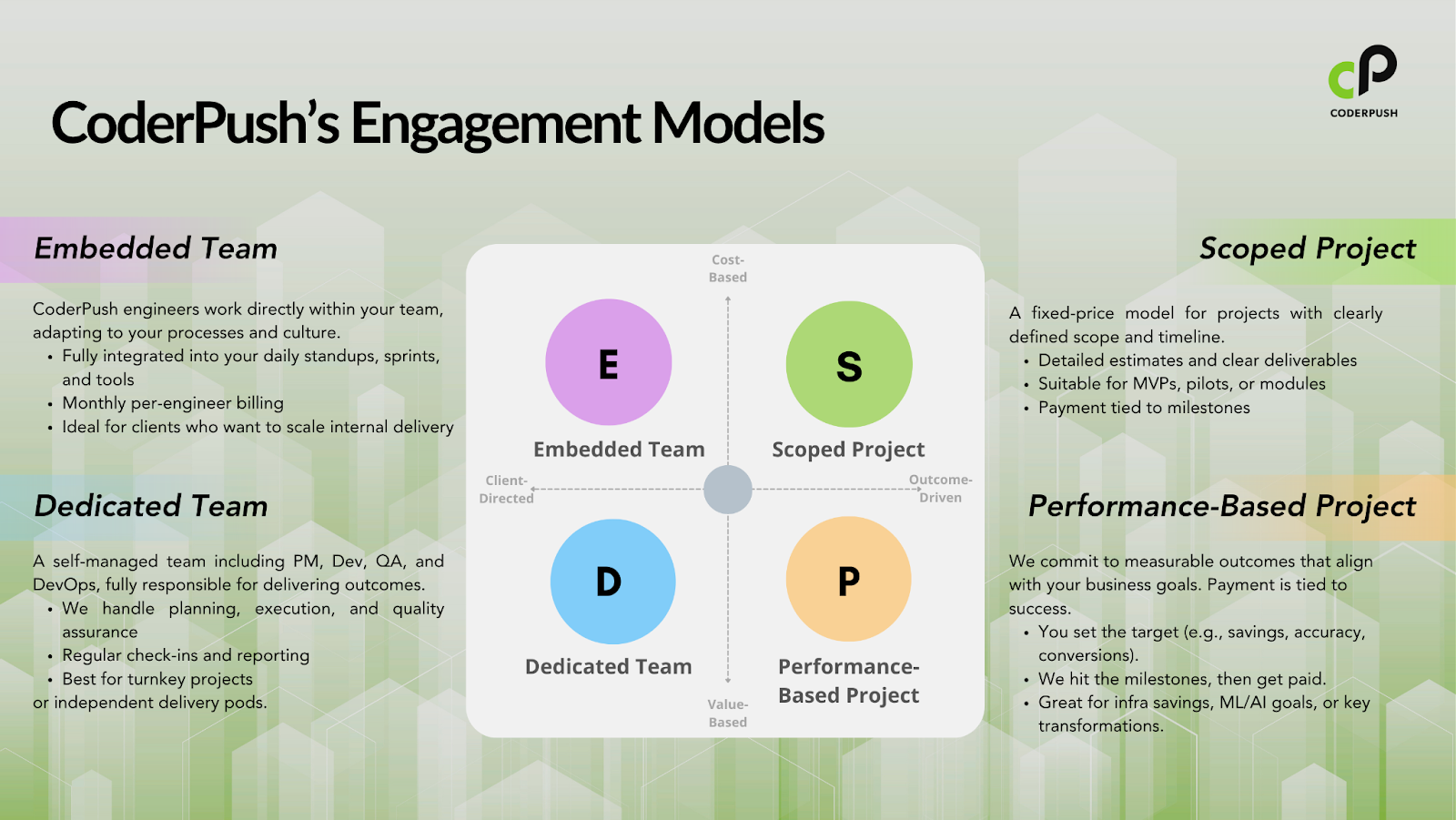
Why Engagement Models Are Critical in 2025
An engagement model serves as the framework for collaboration between a client and their software development partner, defining responsibilities, communication protocols, payment structures, and control levels. Industry insights underscore that choosing the right model is pivotal for managing budgets, ensuring flexibility, and mitigating risks. In 2025, with AI adoption surging and talent shortages persisting, the Embedded Team Model is increasingly vital for businesses seeking to scale rapidly without the overhead of traditional hiring. This model aligns with the industry’s emphasis on agility and specialized expertise, enabling companies to stay competitive in a tech-driven world where speed and adaptability are paramount.
Understanding the Embedded Team Model
The Embedded Team Model integrates CoderPush’s skilled engineers directly into your existing development team, functioning as a seamless extension of your workforce. Unlike traditional outsourcing, where teams operate independently, this model fosters deep collaboration by embedding our engineers into your daily standups, sprints, and tools. It’s designed for companies with established in-house teams that need to augment capacity or access specialized skills, such as AI, machine learning, or modern front-end frameworks, while maintaining full control over project direction.
How the Embedded Team Model Works
CoderPush engineers work directly within your team, adapting to your processes and culture with precision. This hands-on integration ensures they become a natural part of your workflow. Key features, as highlighted by your leadership, include:
- Fully Integrated Collaboration: Our engineers participate in your daily standups, sprint planning, and code reviews, using your preferred tools like Jira, GitHub, or Slack to align with your agile or DevOps practices.
- Monthly Per-Engineer Billing: This predictable cost structure simplifies budgeting, with transparent pricing based on the number of engineers embedded, offering flexibility without hidden fees.
- Ideal for Scaling Internal Delivery: Perfect for clients aiming to boost their team’s output, this model allows you to scale capacity seamlessly as project demands evolve.
- Cultural and Process Adaptation: Engineers are vetted for technical expertise and cultural fit, ensuring they align with your team’s values and operational style, fostering a cohesive work environment.
This model is particularly relevant in 2025, as companies increasingly leverage external talent to address skill gaps in emerging technologies like generative AI, cloud computing, and blockchain, while maintaining close oversight of their projects.
Who Benefits from the Embedded Team Model?
The Embedded Team Model is versatile, catering to a diverse range of businesses:
- Rapidly Scaling Startups: After securing funding, startups need to expand engineering capacity quickly to meet product milestones. The Embedded Team Model provides immediate access to talent, bypassing lengthy recruitment cycles.
- Companies with Skill Gaps: If your team lacks expertise in areas like AI-driven analytics, Web3 development, or advanced front-end frameworks (e.g., React, Vue.js), CoderPush engineers fill those gaps seamlessly while integrating into your existing processes.
- Enterprises with Strategic Initiatives: Large organizations use this model to accelerate projects like legacy system modernization, new feature development, or internal tool creation without disrupting existing workflows, leveraging the adaptability of embedded engineers.
Key Benefits of the Embedded Team Model
- Accelerated Delivery: Onboard expert engineers in days, not months, aligning with the industry’s push for faster time-to-market in 2025, thanks to their immediate integration into your standups and sprints.
- Cost Efficiency: Avoid the overhead of full-time hires, including benefits, onboarding, and infrastructure costs. Monthly per-engineer billing ensures predictability and scalability.
- Scalable Flexibility: Adjust team size based on project needs, ideal for dynamic markets where requirements shift rapidly, with embedded engineers adapting to your evolving tools and processes.
- Deep Collaboration: Embedded engineers integrate into your workflows, fostering knowledge transfer and alignment with your vision through daily interactions and shared tools.
- Access to Specialized Expertise: Tap into CoderPush’s talent pool, with expertise in AI, cloud computing, and modern software architectures, addressing the 2025 talent shortage while aligning with your culture.
Market Trends Driving the Embedded Team Model
In 2025, the software development market is shaped by rapid technological advancements and talent scarcity. Industry reports highlight a 44% increase in demand for AI and cloud computing expertise, with companies increasingly relying on external talent to augment in-house teams. The Embedded Team Model aligns with this trend, offering a cost-effective way to access niche skills without long-term commitments. The rise of hybrid work models and advanced collaboration tools (e.g., Zoom, GitLab) has made remote team integration more seamless, with real-time standups and shared tools enhancing productivity. Additionally, McKinsey’s 2025 technology trends report notes that businesses adopting flexible engagement models like the Embedded Team Model are better equipped to handle skill disruptions and deliver projects faster.

Why Choose CoderPush for the Embedded Team Model?
CoderPush stands out by prioritizing transparency, quality, and alignment, ensuring our engineers work effectively within your team. We offer:
- Tailored Talent Matching: We select engineers based on your project’s specific needs, tech stack, and cultural fit, ensuring they adapt to your processes.
- Transparent Reporting: Regular progress updates and time tracking, integrated into your sprint reviews, ensure accountability.
- Agile Integration: Our engineers align with your agile workflows – whether Scrum or Kanban – participating in standups and using your tools for seamless collaboration.
- Scalable Solutions: Adjust team size as your project evolves, with no long-term lock-in, ideal for scaling internal delivery.
Is the Embedded Team Model Right for You?
If your business needs to scale rapidly, fill skill gaps, or accelerate a project while maintaining control, the Embedded Team Model is a strategic choice. It’s particularly suited for companies navigating the complexities of 2025’s tech landscape, where agility, expertise, and cultural alignment are paramount. This model empowers you to leverage external talent as a natural extension of your team, driving innovation through integrated standups, sprints, and tools.
In Part 2 of our series, we’ll explore the Scoped Project Model, ideal for projects with clear requirements and fixed budgets. Ready to amplify your team with the Embedded Team Model?
👉 Connect with CoderPush today to discuss your needs and start scaling!