
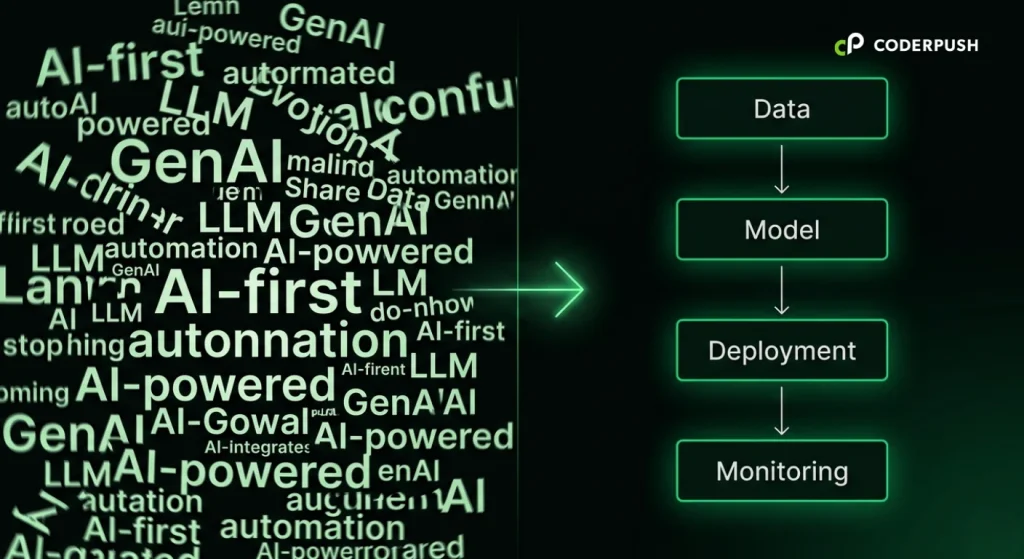
Open any software outsourcing directory in 2026 and count how many vendors call themselves “AI-first.” The number is overwhelming – and meaningless.
When every company, from a two-person agency to a 5,000-seat BPO, slaps “AI-first” on their homepage, the label stops being a differentiator and starts being noise. Worse, it actively misleads buyers. The FTC brought at least a dozen AI-washing enforcement cases in 2025 alone, targeting companies that overstated what their AI could actually do. The SEC charged a startup whose app claimed 90% AI automation – when the real rate was essentially zero, with manual workers doing the job behind the scenes.
If you’re searching for an AI development company in Vietnam or evaluating an AI development partner in Vietnam, this article explains why “AI-first” is the wrong filter – and what to use instead.
Quick Answer
Does “AI-first” still matter when choosing an AI vendor? No. The label has become meaningless marketing. Over 80% of AI projects fail before delivering business value (RAND Corporation, 2025), and the gap between claiming AI capability and delivering production-ready AI systems is where most vendor relationships break down. What matters is execution: MLOps maturity, production track record, developer retention, and system design depth.
What Is an AI Development Company?
An AI development company is a team that designs, builds, and deploys AI systems in production environments. This includes machine learning, generative AI, and the infrastructure required to run them at scale.
The “AI-First” Inflation Problem
The term “AI-first” originally meant something specific: a company whose core engineering, product decisions, and architecture were designed around machine learning from the ground up – not bolted on afterward.
By 2026, that meaning has been diluted beyond recognition.
In Vietnam alone, the AI market has reached an estimated USD 2.1 billion (VINASA, 2026), growing over 340% from its 2023 baseline. The number of businesses adopting AI jumped from 13% to 18% in a single year – roughly 170,000 companies. Five new enterprises adopted AI every hour in 2024.
This explosive growth is real. But it also means every software shop with a ChatGPT API key now markets itself as an AI development company. The result is a market where the label “AI-first” tells you almost nothing about a vendor’s actual capability.
CoderPush POV: We’ve seen this inflation firsthand. When US product teams come to us after a failed engagement, the story is remarkably consistent: the previous vendor had “AI” all over their website but couldn’t explain their MLOps pipeline, had never deployed a model to production, or treated every project as an API wrapper around a foundation model. The label looked right. The engineering wasn’t there.
What the Data Says: Why Most “AI-First” Claims Don’t Survive Contact with Production
The numbers are stark. According to theRAND Corporation’s 2025 analysis, 80.3% of AI projects fail to deliver intended business value. The breakdown tells the real story: 33.8% are abandoned before production, 28.4% reach completion but miss their value targets, and 18.1% deliver some value but can’t justify the investment.
MIT Sloan’s research is even more pointed: 95% of generative AI pilots fail to scale to production deployment. Gartner found that only 48% of AI initiatives make it past the pilot stage, and even successful ones take an average of 8 months from prototype to production.
S&P Global reported that 42% of companies abandoned most of their AI initiatives in 2025 – up from 17% in 2024. That acceleration should concern anyone evaluating AI vendors.
These failures aren’t happening because the models don’t work. The technology is sound. What’s failing is execution – the gap between a demo and a system that runs reliably in production, at scale, under real-world conditions.
This is exactly the gap that separates a genuine AI development partner Vietnam from one that merely claims the title.
The Three Things That Actually Matter (Instead of “AI-First”)
1. Production Track Record, Not Demo Portfolio
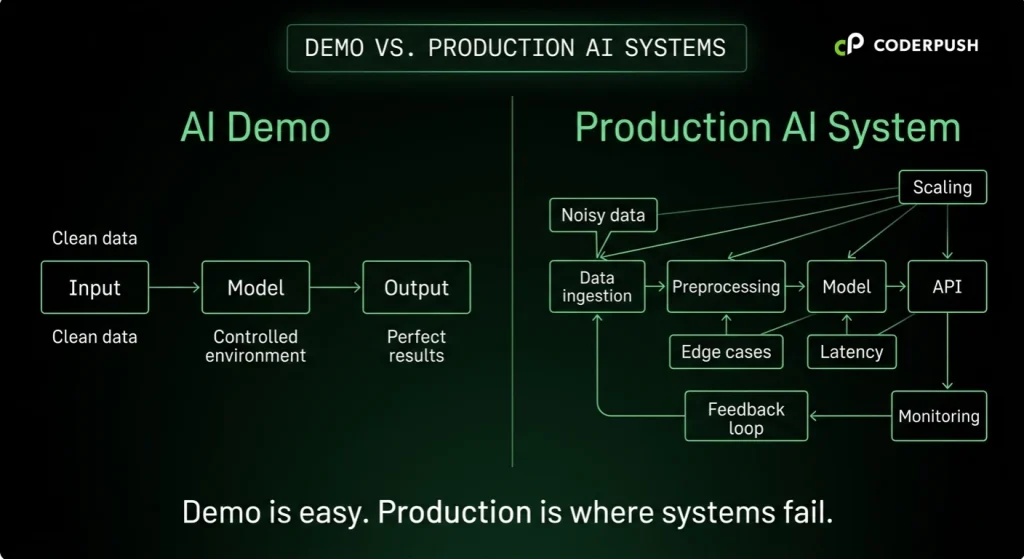
Every AI vendor can show you a demo. Demos are designed to impress. They run on clean data, in controlled environments, with handpicked examples.
Production is different. Production means handling edge cases, managing token costs at scale, building observability into non-deterministic systems, and maintaining performance when your document corpus triples. Production means your RAG pipeline still retrieves accurate answers at 3 AM on a Saturday when nobody is watching.
When evaluating any AI development company Vietnam, the first question should be: “Show me a system you’ve taken from prototype to production – and show me it’s still running.”
CoderPush POV: At CoderPush, we define production readiness as day-one requirement, not a post-launch aspiration. Our engineers design for scalability, observability, and cost efficiency before code reaches real users. From custom RAG pipelines to autonomous agent workflows to cloud-native AI infrastructure on AWS or Azure, every architecture decision is tied to a measurable business outcome – not a slide deck.
2. MLOps Maturity, Not Model Expertise
Knowing how to fine-tune a model is table stakes in 2026. What separates real AI engineering partners is what happens after training: deployment, monitoring, versioning, rollback, cost tracking, and data governance.
Ask your potential vendor: “Show me your MLOps pipeline.” If the conversation immediately shifts to model accuracy and training data – without mentioning deployment automation, inference monitoring, PII masking, or model versioning – you’re talking to a team that builds science projects, not production systems.
The organizations in the 20% that succeed with AI share a common trait: they invest 40–50% of total project resources in data and infrastructure foundations before touching model development. Teams that skip this step pay 2.8× more in remediation costs later.
3. Retention and Ownership, Not Headcount
AI systems aren’t interchangeable. The engineer who designed your chunking strategy, chose your embedding model, and tuned your guardrails holds context that can’t be documented in a wiki. When that person leaves – and in markets with 20%+ attrition, they will – the replacement doesn’t just need to learn the code. They need to re-learn every domain-specific decision.
Vietnam has a structural advantage here. Developer retention rates among Vietnamese AI teams average 15–20% turnover – notably lower than many competing markets. In the broader Vietnamese IT workforce, 55% of professionals prioritize career stability over frequent job changes.
This matters because the team that builds your MVP should be the same team that scales it. Continuity isn’t a soft benefit – it’s an engineering requirement for AI systems where context is the product.
CoderPush POV: We build focused AI squads of 5–15 engineers that integrate directly into our clients’ sprint cycles. Our engineers aren’t ticket-takers – they participate in architectural reviews, challenge product assumptions, and push back when a feature request would compromise system integrity. When a CoderPush engineer says “given the token costs and latency, we should try a different approach,” that’s the ownership mindset that prevents expensive rework. This is what we mean when we say we’re an AI development partner – not a vendor, but an embedded extension of your product team.
How to Vet an AI Development Partner Vietnam: 5 Questions
Stop asking vendors if they’re “AI-first.” Start asking these:
“Show me your MLOps pipeline.” If they only discuss training and not deployment, monitoring, and versioning – walk away.
“How do you handle data privacy for LLMs?” Look for concrete knowledge of PII masking, data residency requirements, and sovereign hosting options.
“What is your developer retention rate over the last 24 months?” Anything above 15% for AI-specific roles should prompt deeper questions.
“Walk me through a project that failed – and what you learned.” Vendors who’ve never failed either haven’t done enough production work or aren’t being honest.
“Who on your team has shipped AI to production – not built a demo, shipped to production?” The gap between demo engineers and production engineers is the gap between an 80% failure rate and the 20% that succeed.
>>Read more: How to Choose an AI Development Company in Vietnam (2026 Guide for US Businesses)
Where CoderPush Fits
CoderPush is an AI-first engineering partner based in Vietnam – but we earn that label through delivery.
We operate as an embedded extension of US product teams, taking ownership of architecture, infrastructure, and long-term AI system performance. Our engineers are vetted for technical depth in machine learning, LLMs, and MLOps – and equally for product thinking, system design capability, and the willingness to challenge bad requirements.
CoderPush is built for:
- Startups and scale-ups building AI-native products who need architectural guidance, not just execution
- Product teams modernizing legacy systems with AI who need partners that understand both the old and the new
- Companies seeking long-term AI partners who value team stability and production ownership over volume staffing
Our goal is straightforward: help you move from prototype to production with confidence, speed, and architectural discipline – so you join the 20% that succeed, not the 80% that don’t.
FAQ
Q: Why doesn’t “AI-first” matter anymore when choosing an AI vendor? The term has been diluted by widespread marketing adoption. The FTC brought a dozen AI-washing cases in 2025 alone. With 80%+ of AI projects failing (RAND, 2025), the label tells you nothing about a vendor’s ability to deliver production-ready systems. Evaluate execution instead.
Q: What should I look for in an AI development company Vietnam? Focus on three things: production track record (systems running in production, not just demos), MLOps maturity (deployment, monitoring, versioning – not just model training), and team retention (low attrition ensures the engineers who build your system are the ones who maintain and scale it).
Q: How do I evaluate an AI development partner Vietnam? Ask to see their MLOps pipeline, their data privacy practices for LLMs, their developer retention rate, and a real production case study. The best partners will also be able to walk you through a project that didn’t go as planned and what they learned from it.
Q: What is the AI project failure rate in 2026? RAND Corporation reports an 80.3% overall failure rate. MIT Sloan found 95% of GenAI pilots fail to scale. Gartner reports only 48% of AI projects reach production, with an average 8-month prototype-to-production timeline for those that do.
Q: Is Vietnam a good market for AI development outsourcing? Vietnam’s AI market is estimated to reach USD 2.1 billion in 2026, with 20%+ annual growth. The ecosystem offers focused depth in areas like fintech, cybersecurity, and computer vision, with notably higher developer retention than many competing outsourcing markets.
Looking for an AI development partner that earns the label through delivery? Talk to us if you’re evaluating AI vendors after a failed build.