

This is the story we hear over and over again at CoderPush – and it’s the reason we built our AI engineering practice around retention, ownership, and production readiness instead of rate-card arbitrage.
If you’re planning to hire AI engineers in 2026, this article breaks down the real economics that most vendor comparison guides won’t tell you.
TL;DR
Why do cheap AI engineers become expensive? Because low hourly rates hide high attrition (20%+ annually in some markets), rework costs, management overhead, and lost institutional knowledge. When you factor in Total Cost of Ownership – including rebuild cycles, onboarding delays, and production failures – the “cheapest” option often costs 1.5–2× more than a slightly higher-rate team with strong retention and product ownership.
The $25/Hour Illusion: What the Rate Card Doesn’t Show You
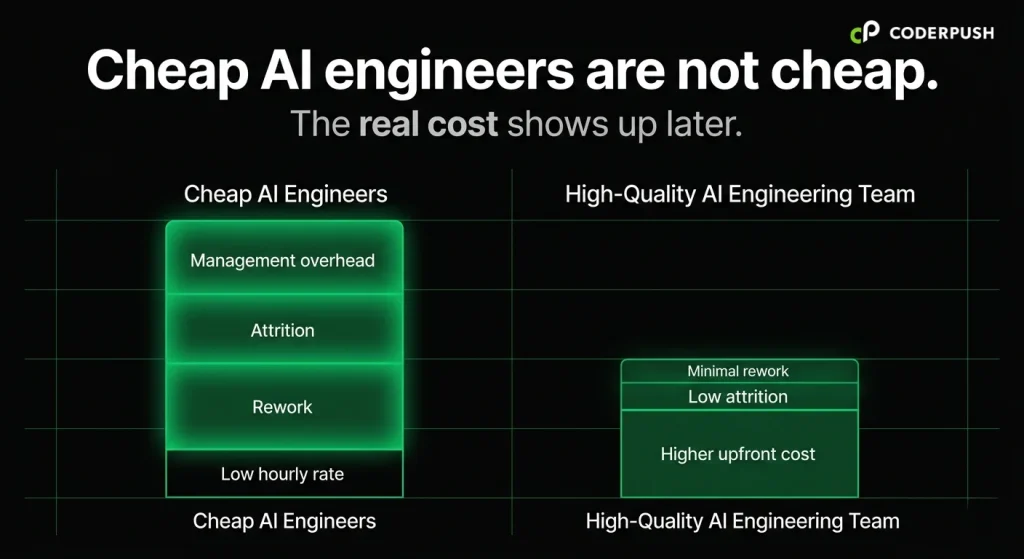
When US and European companies set out to hire AI engineers remotely, the first filter is almost always price. And on paper, the numbers are compelling: a senior AI engineer in Bangalore can be sourced for $25–$80/hour, while Vietnam typically ranges from $30–$55/hour.
But the hourly rate is the sticker price, not the total cost. Here’s what sits underneath.
1. Attrition: The Silent Budget Killer
India’s technology sector saw attrition of 20.5% in 2025, according to an EY compensation survey. In specialized AI teams within Global Capability Centers (GCCs), the numbers are even more alarming – attrition rates between 15–20%, with nearly 60% of AI hiring coming from poaching rival centers rather than net-new talent development.
What does this mean in dollars?
Industry research consistently shows that replacing a single software engineer costs 50–150% of their annual salary when you account for recruiting fees, onboarding time, lost productivity, and knowledge transfer gaps. For a senior AI engineer earning $60,000/year offshore, that’s $30,000–$90,000 per departure – and in a team of 10 with 20% annual churn, you’re looking at two departures per year minimum.
CoderPush POV: At CoderPush, we’ve maintained developer retention rates significantly above the industry average. Our philosophy is simple: the team that builds your MVP should be the same team that scales it to Version 3. Every departure resets context, breaks architectural continuity, and introduces regression risk in production AI systems. When you hire AI engineers Vietnam through our model, you’re buying continuity – not just capacity.
2. The “Management Tax” on Large Vendor Teams
Larger outsourcing operations – particularly in high-volume markets – often require US-side management layers just to keep work on track. CTOs regularly report spending 15–20 hours per week on vendor coordination that was supposed to be “hands-off.”
This management tax shows up in several forms:
- Requirement misalignment. A cultural tendency to agree to every deadline (“yes, we can do that by Friday”) leads to delivery friction when timelines slip.
- Architecture drift. When engineers cycle in and out, system design decisions get lost. The new developer doesn’t know why a particular embedding model was chosen, so they default to whatever they used at their last job.
- Quality variance. In markets with massive talent pools, quality ranges from world-class researchers to junior developers who’ve completed a two-week LLM bootcamp. Vetting becomes a full-time job.
CoderPush POV: We operate as an embedded extension of US product teams – not a ticket factory. Our engineers participate in sprint planning, architectural reviews, and retrospectives. When a CoderPush engineer says “I know you asked for this feature, but given the token costs and latency, we should try a different approach,” that’s not pushback – it’s the product-first mindset that prevents expensive rework downstream.
3. Rework and Rebuild Cycles
Here’s where “cheap” gets truly expensive. A low-cost team that delivers a working demo but not a production-ready system creates a rebuild cycle:
- Demo → Production gap. The prototype uses hardcoded API keys, no observability, no error handling, and a prompt chain that breaks with edge cases. Getting this to production isn’t iteration – it’s a rewrite.
- Technical debt compounds. Every shortcut taken by a rotating team becomes a tax on the next sprint. After 6 months of compounding shortcuts, refactoring can consume 40–60% of engineering capacity.
- MLOps absence. If your offshore team only knows how to train models but not deploy, monitor, or version them, you’ve built a science project – not a product.
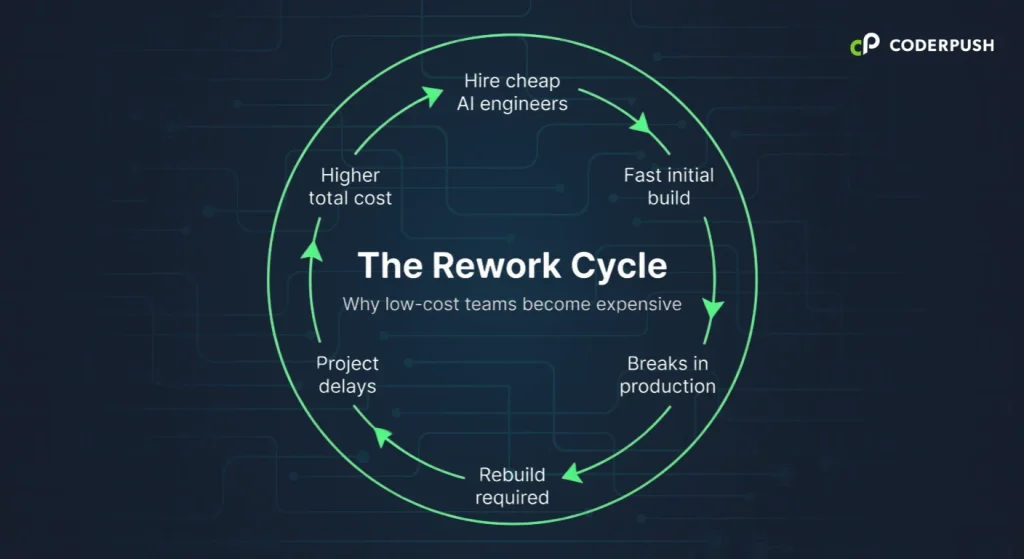
An Oxford University study found that a project delay of just 11% can increase total project cost by 5%. For a six-month AI project with a $500,000 budget, that’s $25,000 burned on a single timeline slip – and most rework cycles cause far more than 11% delay.
The Total Cost of Ownership (TCO) Framework
Instead of comparing hourly rates, smart CTOs in 2026 are evaluating vendors on TCO. Here’s the framework:
What Goes Into TCO
The math is counterintuitive but consistent: a team at $45/hour with 5% attrition almost always costs less over 12 months than a team at $28/hour with 20% attrition.
(Estimated based on industry data)
>> Vietnam vs India: Which Is Better for Hiring AI Engineers in 2026?
Why This Problem Is Amplified for AI Engineering Specifically
AI engineering isn’t like building a standard web application. The cost of turnover is amplified by several unique factors:
Context Is the Product
In AI systems – especially RAG pipelines, autonomous agents, and fine-tuned models – the engineering decisions are deeply contextual. Which chunking strategy works for your specific document corpus? What guardrails prevent your agent from hallucinating in your specific domain? These aren’t things you can document in a wiki. They live in the team’s collective understanding.
When that team churns, the context walks out the door.
Production AI Requires Cross-Disciplinary Depth
The modern AI engineer role in 2026 has split from the traditional ML researcher. Companies need engineers who understand vector databases, sovereign cloud infrastructure, PII masking for LLMs, cost optimization across inference endpoints, and observability for non-deterministic systems – all at once.
Finding this combination at $25/hour isn’t just unlikely. It’s a signal that you’re getting someone who claims these skills but hasn’t operated them in production.
The “API Wrapper” Problem
In every outsourcing market, the AI boom has created a wave of agencies that relabel basic integration work as “AI engineering.” They can connect your app to the OpenAI API. But can they design a multi-agent orchestration system with fallback routing, token budget management, and human-in-the-loop escalation? The gap between an API wrapper shop and a production AI team is the gap between a demo and a product.
CoderPush POV: This is exactly why we vet engineers not only for technical expertise in ML, LLMs, and MLOps, but also for product thinking and system design. When evaluating any AI partner – in Vietnam, India, or anywhere – we recommend asking three questions:
- “Show me your MLOps pipeline.” If they only talk about training models, not deploying and monitoring them, walk away.
- “How do you handle data privacy for LLMs?” Look for knowledge of PII masking and sovereign hosting.
- “What is your developer retention rate over the last 24 months?”
A Decision Framework: Hire AI Engineers the Right Way
Before you sign with any vendor, run this checklist:
The 5 Questions That Reveal True Cost
- What is your team’s attrition rate over the past 24 months? Anything above 15% for AI roles should trigger concern.
- Will the engineers who start the project still be on it in 12 months? If the vendor can’t commit to this, factor in at least one full ramp-up cycle.
- Show me a system you’ve taken from prototype to production. Demos are easy. Production is where cost discipline lives.
- How do you handle mid-project knowledge transfer? If the answer is “documentation,” that’s not enough for AI systems.
- What does your MLOps and monitoring stack look like? If they don’t have one, you’re hiring a research team, not a production team.
The CoderPush Approach
At CoderPush, we’ve built our model around the principle that the most expensive engineer is the one who leaves – or the one who builds something that has to be rebuilt. As an AI-first engineering partner based in Vietnam, we focus on:
- Embedded squads, not body-shopping. Our engineers integrate directly into your sprint cycles.
- Production readiness from day one. Scalable, observable, and cost-efficient before it reaches real users.
- Long-term partnership, not short-term contracting. We’re built for the team that stays from MVP through Version 3 and beyond.
Whether you’re a Series A startup building your first AI-native product or an enterprise modernizing legacy systems with AI, the question isn’t “what’s the cheapest rate?” – it’s “what’s the fastest path to production-ready AI that doesn’t need to be rebuilt?”
FAQ: Hiring AI Engineers – Cost, Quality, and Retention
Q: Why do cheap AI engineers end up costing more? Low rates often correlate with high attrition, limited production experience, and management-heavy engagement models. When you add replacement costs (50–150% of salary per departure), rework cycles, and US-side management overhead, the TCO frequently exceeds higher-rate, retention-focused alternatives.
Q: What’s the average cost to replace an AI engineer? Industry data puts the cost at 50–150% of annual salary, factoring in recruiting, onboarding, lost productivity, and knowledge gaps. For specialized AI roles, the upper end of that range is more common due to the scarcity of production-experienced talent.
Q: Is it better to hire AI engineers in Vietnam or India? It depends on your use case. India excels at massive scale and legacy enterprise needs. Vietnam is increasingly the stronger choice for focused, product-led AI teams of 5–15 engineers where retention, production ownership, and architectural depth matter most.
Q: What should I look for when I hire AI engineers remotely? Look beyond hourly rates. Evaluate retention rates, production track records (not just demos), MLOps maturity, data privacy practices, and whether the team demonstrates a product mindset versus a ticket-execution mindset.
Q: How does CoderPush help companies hire AI engineers in Vietnam? CoderPush operates as an embedded AI engineering partner, providing vetted squads with expertise in LLMs, RAG pipelines, MLOps, and cloud-native AI infrastructure. We prioritize team stability, production readiness, and business-aligned engineering – not volume staffing.
Ready to build your AI team the right way? Talk to CoderPush about how our embedded AI engineering squads deliver production-ready systems without the hidden costs of high-turnover hiring.