

By 2026, the question for US and European tech leaders is no longer “Should we offshore AI development?” but rather “Where is the talent that can actually move the needle on our ROI?” Companies are now looking for production-ready AI systems—autonomous agents, integrated RAG pipelines, and MLOps—not just wrappers around GPT-4.
When it comes to Vietnam vs India for AI engineer staffing, the choice often boils down to a trade-off between massive scale and agile product focus. This guide breaks down how these two hubs compare across talent, cost, and culture to help you decide which is the next prominent team for your AI projects.
1. Why Are US Companies Offshoring AI Engineering in 2026?
While basic coding is increasingly automated, the demand for AI Engineers who can design secure, scalable, and observable AI systems has skyrocketed.
US companies are offshoring specifically to address:
The Specialized Talent Shortage:
Finding a senior ML engineer who understands both vector databases and sovereign cloud infrastructure is extremely difficult, and often the cost is out of hand, with the average of over $200k this year for Senior Lead AI in San Francisco.
24/7 Innovation Cycles:
To stay ahead of competitors, many companies adopt a “follow-the-sun” development model, where AI systems continue to be refined while the US team is offline. This enables continuous progress without overloading local engineering teams.
Production Readiness:
In 2026, the “AI Engineer” role has split. US companies need offshore teams that don’t just execute tickets but can handle MLOps and Data Governance.
2. Overview: AI Talent Landscape in Vietnam vs India
To have a broader vision, the chart below compares the capabilities of two significant outsourcing companies in India and Vietnam:
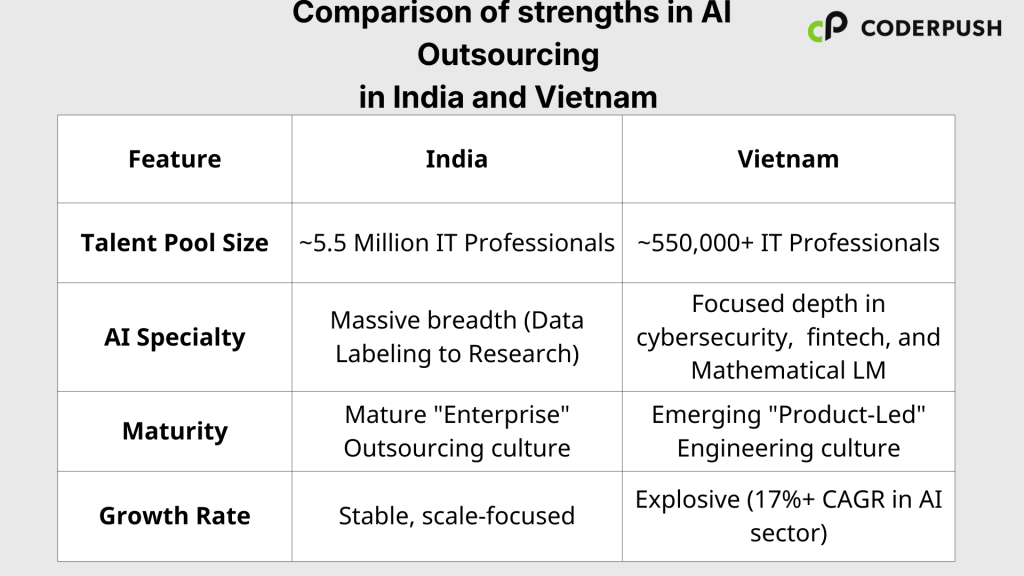
(Source: dirox.com)
It can be seen that India offers a vast ocean of talent. For instance, 500 data engineers are always ready to clean a massive healthcare dataset. While India’s infrastructure is unmatched, Vietnam’s AI ecosystem is rapidly growing, driven by strong demand and a young engineering workforce.
According to the Vietnam’s AI Economy 2025 report, Vietnam has advantages in localized tasks such as Vietnamese language processing, computer vision, process automation for small and medium-sized enterprises, as well as AI applications in manufacturing.
3. Cost Comparison: Vietnam vs India for Hiring AI Engineers
The cost of outsourcing doesn’t just stop at the initial hiring cost. When investors look at hourly rates, they often overlook the bigger picture, consisting of all the costs involved in hiring an outsourced team, including base salary, management overhead, application setups, rebuild cost, etc. In short, India could be generally cheaper on an hourly basis, but Vietnam often wins on the “Total Cost of Ownership” (TCO).
The Hourly Rate Reality
In 2026, a senior AI engineer in India might range from $25 to $80/hour, depending on the city (Bangalore being the most expensive). In Vietnam, rates for similar seniority typically sit between $30 and $55/hour.
The Hidden Costs of Scale
While India’s entry-level rates are lower, US CTOs often report “management tax” in larger Indian firms.
- Attrition: India’s tech hubs face high turnover rates (often 20%+), leading to lost institutional knowledge.
- Stability: Vietnam’s developer retention is significantly higher, with 55% of IT professionals prioritizing career stability over frequent job-hopping. In 2026, many US firms are choosing Vietnam because the team that builds the MVP is the same team that scales it to Version 3.
If your goal is “lowest possible hourly rate,” go with a mid-tier Indian vendor. If your goal is “highest code-to-dollar ratio,” Vietnam’s specialized squads often prove more efficient.
4. Vietnam vs India: Talent, Work Culture, and Collaboration
Often, recruiters underestimate the importance of human factors compared to technical expertise, as their contribution seems less significant when looking at the final results. However, communication plays a crucial role in how engineers assess and perceive problems, thereby improving work efficiency.
1. Communication and Cultural Compatibility
India has a massive advantage in fluent English speakers. However, the cultural habit of “pleasing the client” (saying yes to unrealistic deadlines) can lead to delivery friction.
English proficiency in Vietnam has improved drastically for the top 10% of engineers. Culturally, Vietnamese engineers tend to be more direct. In a product-led environment, you want an engineer who says: “I know you asked for this feature, but given the token costs and latency, we should try this approach instead.”
2. Time Zone Overlap
Both are roughly 11–12 hours ahead of the US East Coast. This creates a “perfect hand-off” model.
- Vietnam: Generally works well with West Coast teams for evening/morning syncs. However, it might be a little tricky when Vietnamese teams often start to work when the other team leaves their desks.
- India: Has a slight advantage for East Coast teams due to the 9.5-hour difference (IST).
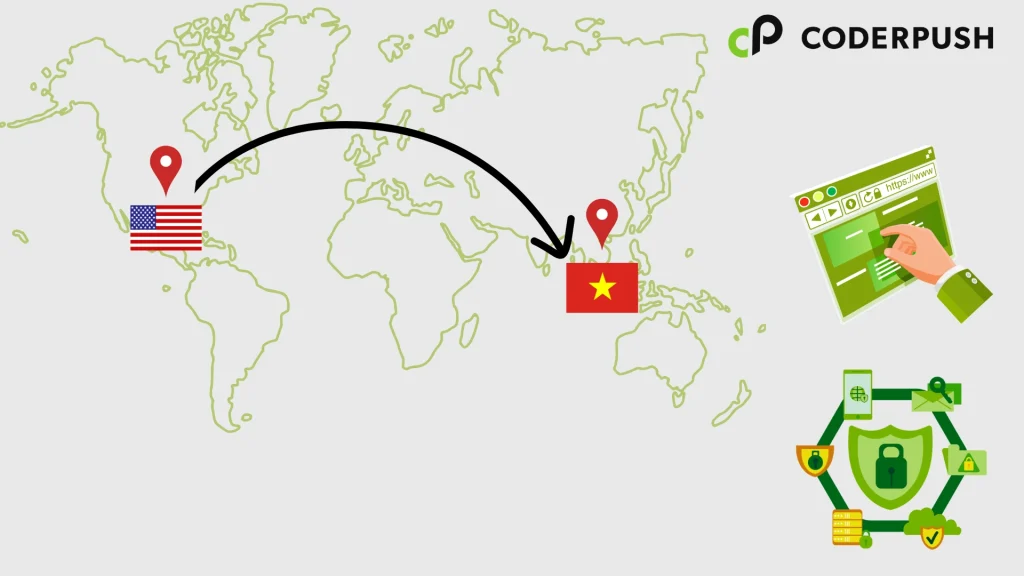
(Vietnam is an ideal outsourcing market due to its compatibility with the US companies)
3. Quality, Product Mindset, and Production Readiness
Where do you find engineers who think like owners?
- India: Because of its history as an outsourcing hub, many Indian engineers are trained in a “waterfall” or “ticket-based” mindset. Quality varies wildly; you can find world-class researchers at Tier-1 firms, but generic shops often struggle with high-level system design.
- Vietnam: The ecosystem is smaller and more intimate. Many engineers in Ho Chi Minh City and Hanoi have worked at US-funded startups. This has bred a product-first mindset. They don’t just build a model; they care about the System Design, Observability, and how the AI affects the user experience.
4. Availability of AI-Focused Partners
In 2026, everyone claims to be an “AI Development Company.”
In India, the challenge is vetting. In the largest market globally, like India, the Senior AI Lead position is often diluted, making it harder to find a suitable candidate, and it requires a rigorous technical interview process to bypass the “API-wrapper” agencies.
In Vietnam, the AI-first community is more concentrated. With the help of the Vietnam National AI Strategy through 2030, hubs like Da Nang and HCMC have birthed specialized AI-native teams like CoderPush, which focus exclusively on modern AI stacks rather than legacy Java or .NET maintenance.
5. When Vietnam Is the Better Choice (and When India Is)
Choose Vietnam if:
- You are a Series A-C startup or a scale-up needing an elite, 5–15 person AI squad.
- You need a partner who can provide architectural guidance, not just execution.
- You value long-term team stability and low attrition.
Choose India if:
- You need to hire a large number of developers in 90 days.
- You have an established internal management layer to handle high-volume vendor oversight.
- You need specialized support for legacy enterprise integrations.
6. How to Evaluate AI Partners in Vietnam and India
Don’t just look at the portfolio. Ask these three questions:
- “Show me your MLOps pipeline.” (If they only talk about training models and not deploying/monitoring them, walk away).
- “How do you handle data privacy for LLMs?” (Look for knowledge of PII masking and local/sovereign hosting).
- “What is your developer retention rate over the last 24 months?”
7. Where CoderPush Fits in This Picture
As an AI-first engineering partner in Vietnam, CoderPush is more than a traditional outsourcing vendor. We operate as an embedded extension of US product teams, taking ownership of architecture, infrastructure, and long-term AI system performance.
Our engineers are vetted not only for technical expertise in machine learning, LLMs, and MLOps, but also for product thinking and system design capabilities. We prioritize production readiness from day one – ensuring your AI solution is scalable, observable, and cost-efficient before it reaches real users.
Unlike high-volume staffing firms, we build focused AI squads that integrate directly into your sprint cycles. From designing custom RAG pipelines and autonomous agent workflows to implementing cloud-native AI infrastructure on AWS or Azure, we align engineering decisions with measurable business outcomes.
CoderPush is a strong fit for:
- Startups and scale-ups building AI-native products
- Product teams modernizing legacy systems with AI
- Companies seeking long-term AI partners, not short-term contractors
Our goal is simple: help you move from prototype to production with confidence, speed, and architectural discipline.
8. FAQ: Vietnam vs India for Hiring AI Engineers
Q: Is Vietnam or India better for hiring AI engineers in 2026?
A: Vietnam is better for agile, product-led teams; India is better for massive scale and legacy enterprise needs.
Q: Is it cheaper to hire AI engineers in Vietnam or India?
A: India often has lower entry-level hourly rates, but Vietnam is highly competitive on a “Total Cost of Ownership” basis due to lower attrition and higher efficiency.
Q: What is the main risk of hiring in Vietnam?
A: The talent pool is smaller than India’s, so finding “niche” specialists may take longer.
9. Conclusion: What’s Right for Your AI Team?
In 2026, the “better” destination is the one that aligns with your engineering culture. If you want a massive engine that runs 24/7 at scale, India is your powerhouse. For product-led AI teams prioritizing stability and system ownership, Vietnam is increasingly viewed as a strong strategic option.